Egg Freezing Cost by Age
Capture the age-cost link in one sentence
After turning 35, the typical yearly cost increase ranges from $3,000 to $8,000. As more eggs are required per target, the yield from each cycle declines, and to reach the same probability goal most patients need a second or even a third cycle.
Live-birth per retrieval depends on age band
CDC ART data shows the per-cycle yield gap. These rates come from IVF and frozen-egg-thaw cycles, not from the freezing process itself.[8]
| Age band | Live birth per retrieval | What it means |
|---|---|---|
| Under 35 | ~43% | Live-birth per retrieval (CDC ART data) |
| 35 to 37 | ~31% | Live-birth per retrieval |
| 38 to 40 | ~19% | Live-birth per retrieval |
| 41 to 42 | ~10% | Live-birth per retrieval |
| Over 42 | ~3% | Per-retrieval rates drop steeply |
Calculate realistic total cost by age (mid-tier metro, uninsured)
| Age | Cycles | Total from | Total to | Per expected live birth | Notes |
|---|---|---|---|---|---|
| 28 | 1 | $12,000 | $20,000 | $28K to $47K | Yield typically 14 to 18 mature eggs per cycle. One cycle usually hits target. Most cost-effective freeze age. |
| 30 | 1 | $12,000 | $20,000 | $28K to $47K | Similar to 28. Live-birth-per-retrieval is highest in this age band per CDC ART data. |
| 32 | 1 to 2 | $12,000 | $36,000 | $28K to $84K | Yield still strong. A second cycle becomes more common if first cycle yields under 10 eggs. |
| 35 | 1 to 2 | $15,000 | $36,000 | $48K to $116K | Inflection point. Yield drops, eggs-needed-per-target rises. Most patients in this band do two cycles. |
| 37 | 2 | $25,000 | $40,000 | $81K to $129K | Two cycles is typical. Live-birth-per-retrieval is around half of the under-35 rate. |
| 38 | 2 to 3 | $25,000 | $60,000 | $132K to $316K | Yield per cycle averages 6 to 10 eggs. Eggs needed for 70% target is 26 plus. |
| 40 | 3 | $36,000 | $60,000 | $189K to $316K | Three cycles common. Per-egg success rate continues to drop. |
| 42 | 3 plus | $54,000 | open | $540K+ | Diminishing returns. ASRM 2023 ethics opinion notes the difficulty of guaranteeing meaningful outcome at this age. |
Where these come from: cycle counts follow the ASRM eggs-needed-by-age model[4] and Extend Fertility’s published yield cohort.[17] Per-cycle pricing uses the 2026 consensus range across FertilityIQ, GoodRx and Cofertility. Storage sits outside these totals, so add $4,500 to $9,000 for 10 paid years. Cost per expected live birth divides the realistic total by the CDC live-birth-per-retrieval rate for the band in question. Those rates run 43% below 35, then 31% across 35-37, 19% through 38-40, and 10% at 41-42. The result lands high on purpose: it forces an honest reckoning with what another cycle actually buys, particularly past 38.
An honest take on the best age for freezing
When is the best time to freeze? Ideally before 35, and as soon as you have decided you want the option and can afford it. The explanation follows. Between ages 30 and 34, per-egg success rate and per-cycle yield are at their highest; typically one cycle is enough, so the per-target cost stays low. For ages 35 to 37, the situation is similar but one or two cycles may be needed. After 38, diminishing returns become more pronounced: it may take three cycles to achieve what an under-35 patient gets in one, while per-egg success rate has roughly halved.[5]
38.1% of freezers had returned to use, according to a 2021 Fertility & Sterility utilization cohort. Younger freezers had even lower utilization. A person who freezes too young may freeze unnecessarily and pay storage cost for many years before deciding not to use the eggs. The decision process is covered in detail on is it worth it?
Know what matters at each age
Between 28 and 32
In this age bracket, egg yield is strong per cycle, cost per target is low, and per-egg success odds are best. Usually one cycle works. The trade-off: highest chance eggs sit unused, due to long storage and likely natural conception. So the question: is the option worth $12,000 to $20,000 plus 8 to 12 years of storage?
From 33 to 37
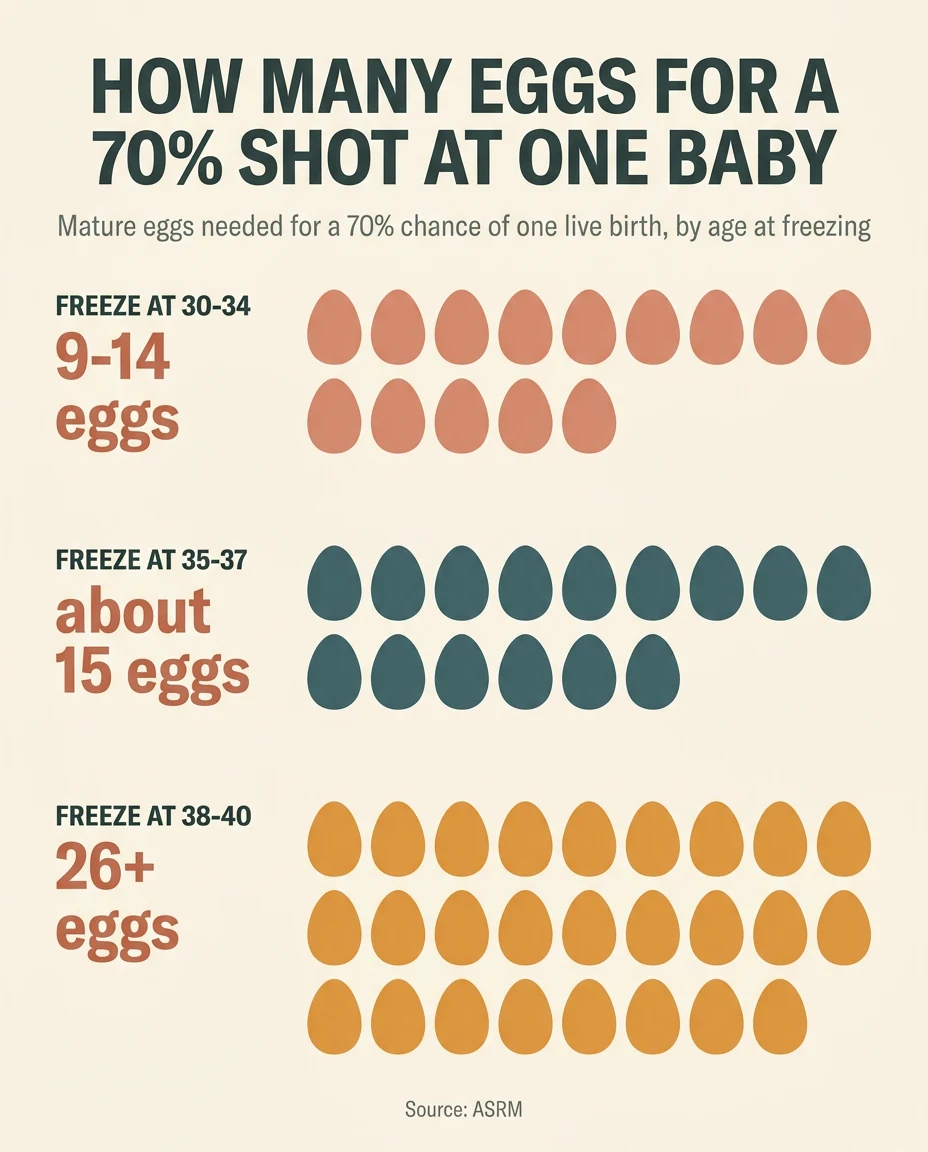
For this age band, the most common one for freezing, the target is 15 mature eggs, and one to two cycles are expected. The total cost ranges from $15,000 to $36,000, plus storage fees. The most critical factor is insurance coverage at this age.
In the 38–40 range
Two to three cycles are typical. Per-egg yield and per-egg success both fall versus under-35 figures. Nuance enters the decision. Many reproductive endocrinologists at this age band discuss with patients whether the chance of a baby is high enough to make the cost worthwhile, especially for those without a partner or sperm source plan.
At 41 and older
Few mature eggs per cycle is common; per-egg live-birth probability sits in low single-digit percent. The ASRM 2023 ethics committee opinion[20] says meaningful probability assurance at this age band is hard to give. Discussions usually cover the donor egg pathway option and how outcomes differ.
Returns diminish as age increases
The ASRM framework says you need 26 mature eggs if you freeze at 38 to 40, and the number gets higher for older ages. A typical retrieval gives 6 to 10 mature eggs, so that means three cycles or more. Each extra cycle costs the same as the first but increases your overall chance of a live birth by a smaller amount. That is why freezing earlier helps: the odds tilt against you with every passing year.
Related articles and resources
- [4] ASRM Practice Committee, Fertility and Sterility, 2021, “Evidence-based outcomes after oocyte cryopreservation for donor oocyte in vitro fertilization and planned oocyte cryopreservation: a guideline”. https://www.asrm.org/practice-guidance/practice-committee-documents/evidence-based-outcomes-after-oocyte-cryopreservation-for-donor-oocyte-in-vitro-fertilization-and-planned-oocyte-cryopreservation-a-guideline/
- [5] Goldman et al., Human Reproduction, 2017, “Predicting the likelihood of live birth for elective oocyte cryopreservation: a counseling tool for physicians and patients”. https://academic.oup.com/humrep/article/32/4/853/3056229
- [17] Extend Fertility, “Egg Freezing Success by Age: Outcomes Data” (checked April 2026). https://extendfertility.com/your-fertility/egg-freezing-success-rates/
- [8] Centers for Disease Control and Prevention, 2022 data, published 2024, “ART Success Rates: National Summary Report”. https://www.cdc.gov/art/reports/2022/national-summary.html
- [6] Cobo et al., Fertility and Sterility, 2016, “Oocyte vitrification as an efficient option for elective fertility preservation”. https://www.fertstert.org/article/S0015-0282(15)02157-7/fulltext
- [20] ASRM Ethics Committee, Fertility and Sterility, 2023, “Planned oocyte cryopreservation for women seeking to preserve future reproductive potential: an ethics committee opinion”. https://www.asrm.org/practice-guidance/ethics-opinions/planned-oocyte-cryopreservation-for-women-seeking-to-preserve-future-reproductive-potential-an-ethics-committee-opinion/